Getting there
On the Marathon des Sables, one of my tent mates spoke about his dream of climbing Everest. In December that year, looking for my next challenge, it came back into my head. I messaged him straight away, and he told me to speak to Lukas Furtenbach of Furtenbach Adventures.
On a one hour call I told Lukas, “I've never climbed a mountain, but I've done a few ultra endurance races,” and named them. He had confidence in me, and set me one high altitude test: Aconcagua. Six months before Everest, the highest I had ever been was 4,100m.
Kathmandu to Base Camp
I flew into Kathmandu to the noise of the streets and a flower garland around my neck, and met Lukas, my guide Benny and the team at the Yak & Yeti. I was the youngest. Nothing new. In business I'm usually the youngest in the room.
What I didn't expect was that the first five weeks would be some of the most boring of my life. Trek, eat, sleep, repeat. Around 40 of us at Base Camp. And a quiet anxiety: with so little experience, if I fell out of favour with my guides, they might decide it was too dangerous to take me to the top. That stayed with me until the moment we left Camp 4.
The climb
We left Base Camp at midnight for the Khumbu Icefall. Many call it the most dangerous part of the expedition. For me it was one of the most exciting: scrambling over colossal blocks of glacier, ducking under seracs the size of houses, all of it creeping down the mountain slower than a snail.
- Camp 16,100 m
- Camp 26,500 m
- Camp 37,100 m
- Camp 47,900 m
- Summit8,848 m
Camp 1. Then through the Valley of Silence to Camp 2. Oxygen masks on for the Lhotse Face, up to Camp 3 halfway. Then a climb and traverse across to the South Col, Camp 4 at 7,900m, arriving at 9AM to rest before leaving for the summit at 9PM.
At 9:05PM I was still tying my boots. Even that is exhausting at 7,900m. My team had already gone. Within 30 minutes we hit traffic, and my Sherpa waved me on to catch up. From Camp 2 to the summit there's a fixed rope you stay clipped to, so if you slip it catches you. To overtake I had to unclip, again and again. Looking back, one of the most dangerous things I've ever done.
By the Balcony I was back with my team. Along the summit ridge we were making such good time in the dark that we slowed down to reach the top at dawn.
At the foot of the Hillary Step, the reality of the mountain was in front of me. A climber who had died years before, frozen into the path. And above the Step, another, still clipped to the rope, who had died the day before. A guide told me he had been humming a song as he passed. “Terrible,” I said. “No,” the guide said. “It's beautiful.” Dying while chasing your dream.
Sunrise
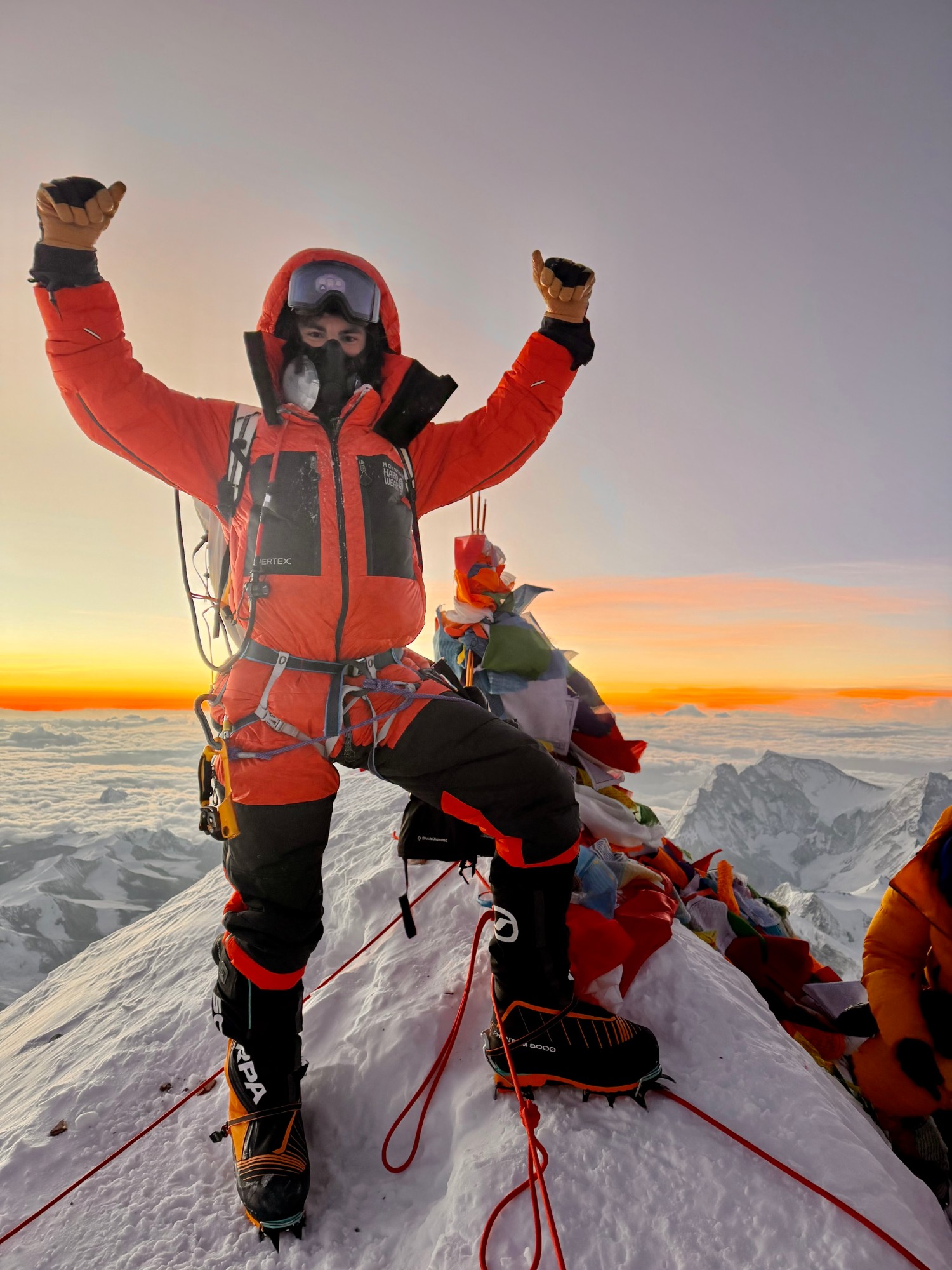
The sky slowly turned from black to orange. A queue formed as all of us waited to stand on the highest point on earth. I fought back tears, half worried they'd freeze. I couldn't celebrate yet. I wasn't safe.
As the sun rose over the horizon I climbed onto the true summit, prayer flags moving in the light wind, and raised my arms. Probably the best photo I'll ever have.
Then the hard part. Most people who die on Everest do so on the way down. The summit ridge is a knife edge with a 3,000m drop into Tibet on one side and 2,500m into Nepal on the other. On the Lhotse Face you descend on grip and the friction of your gloves on the rope. By the bottom my brand new leather gloves were shredded.
Back in the tent at Camp 4, my Australian tent mate and I both shed a tear. We had seen people in the same clothes and boots, with the same dream, who had become part of the mountain.
Lhotse
The plan was never to stop at Everest. Lhotse (8,516m), the fourth highest mountain in the world, was meant to follow the next day. Two 8,000m peaks back to back.
Then the wind came. Gusts rose out of Nepal and tore across the South Col. Tents around us ripped open. An entire camp was being lifted and blown into Tibet. I watched an empty tent tear from the ground and take off towards the edge, until one outstretched hand caught it. A Sherpa in a yellow down suit wrestled it to the ground, took it apart and pinned the pieces under rocks. His name was Mingma, said to have summited more 8,000m peaks than almost anyone. He helped me find a fresh oxygen bottle when mine ran low.
I crawled into the tent of our Argentinian guide. Over cured meat he'd carried from South America, we agreed: if the wind dropped by 9PM, we'd leave at 10.
At 9PM there were no voices outside. Only the wind and the sound of my own breathing through the mask. At Camp 4 you rely completely on bottled oxygen. I slept on it, alone, until sunrise, then we descended to Camp 2, and through the Icefall at night to Base Camp. Lhotse wasn't meant to be.
Home
A helicopter out of Base Camp with duffel bags piled on my lap, two nights in Kathmandu, then London. The day I landed I took the train to Yorkshire to see my mum and show her I was safe.
Thank you to Pemba Nuri Sherpa, who had my life in his hands, to Benny Lieb, and to Lukas Furtenbach for believing in a crazy dream on our first phone call.